
16 Days - From Tropical Basins to Andean Heights
From Tropical Basins to Andean Heights (16D/15N)
Chiquitania, Chaco, Southern Yungas, Inter-Andean Dry Valleys, Chaco Serrano, Northern Yungas & Humid Puna
Bolivia, despite being landlocked, is a remarkable land of striking contrasts and extraordinary natural beauty. From lush rainforests and mystical cloud forests to vast deserts and snow-capped peaks, its landscapes are as diverse as they are breathtaking. Traveling through Bolivia feels like moving through a living mosaic of ecosystems, each shifting and transforming with every step, offering something unique and awe-inspiring. The country’s twelve distinct ecoregions shelter nearly 1,500 bird species, making it a true paradise for birdwatchers.
Situated in the heart of South America, Bolivia acts as a natural bridge between the ecosystems of its five neighboring countries, blending a rich mix of biodiversity while preserving its own unique environmental identity. This fusion creates an unparalleled natural wealth, with landscapes and wildlife found nowhere else on Earth.
The “From Tropical Basins to Andean Heights” route is specially designed for passionate birders eager to build an extensive species checklist while enjoying a comfortable, well-organized journey through some of South America’s most diverse landscapes.
Our adventure begins in the vast lowland plains of Santa Cruz, home to Bolivia’s main international airport and a gateway to exceptional birding. From here, we gradually ascend into the Andes, allowing ample time for acclimatization as we transition from 400 meters above sea level (1,300 fasl) to nearly 5,000 meters (16,500 fasl) at some of our prime birding sites.
This dramatic change in altitude unveils an incredible range of habitats—from tropical lowland forests and Andean foothills to lush cloud forests, high-altitude wetlands, and windswept puna grasslands. Along the way, we explore eight of Bolivia’s twelve ecoregions, immersing ourselves in one of the most biodiverse regions on Earth: the Tropical Andes.
Depending on the season, this route offers the chance to record between 450 and 550 bird species, making it an unmissable experience for any serious birder.
Join us for an unforgettable birding expedition in the heart of South America—where every stop reveals new discoveries, every horizon offers breathtaking scenery, and every day brings the thrill of the unexpected.
Hugo Santa Cruz
CEO of Bolivia Birding Expeditions
Trip Summary
| Bolivia: From Tropical Basins to Andean Heights | |||
| Tour begins in Santa Cruz and ends in La Paz | |||
| Day # | Itinerary | Remarks | Overnight |
| 1 | Arrival to Santa Cruz City | Birding at Viru Viru Airport if possible (L,D) | Santa Cruz |
| 2 | Birding around Santa Cruz City | (B,L,D) | Santa Cruz |
| 3 | Santa Cruz to Amboro National Park (SE) | (B,L,D) | Amboro National Park |
| 4 | Birding at Amboro National Park (SE) | No driving today (B,L,D) | Amboro National Park |
| 5 | Amboro National Park to Perereta | Long driving today (B,L,D) | Red-fronted Macaw Reserve |
| 6 | Birding at Red-fronted Macaw Reserve | (B,L,D) | Comarapa |
| 7 | Pereta to Comarapa | (B,L,D) | Comarapa |
| 8 | Comarapa to Coranipampa | Long driving today (B,L,D) | Coranipampa |
| 9 | Coranipampa to Cochabamba | (B,L,D) | Cochabamba |
| 10 | Birding around Cochabamba | (B,L,D) | Cochabamba |
| 11 | Birding around La Paz | Morning flight to La Paz (B,L,D) | La Paz |
| 12 | Birding at Titicaca Lake and Sorata | Long driving today (B,L,D) | La Paz |
| 13 | La Paz to Acero Marka | Long driving today (B,L,D) | Jucumari Reserve |
| 14 | Birding at Acero Marka | (B,L,D) | Jucumari Reserve |
| 15 | Acero Marka to La Paz | Farewell Dinner (B,L,D) | La Paz |
| 16 | Transfers to La Paz Airport | End of our services (B) | Not included |
B = Breakfast / L = Lunch / D = Dinner
Tour Route Map
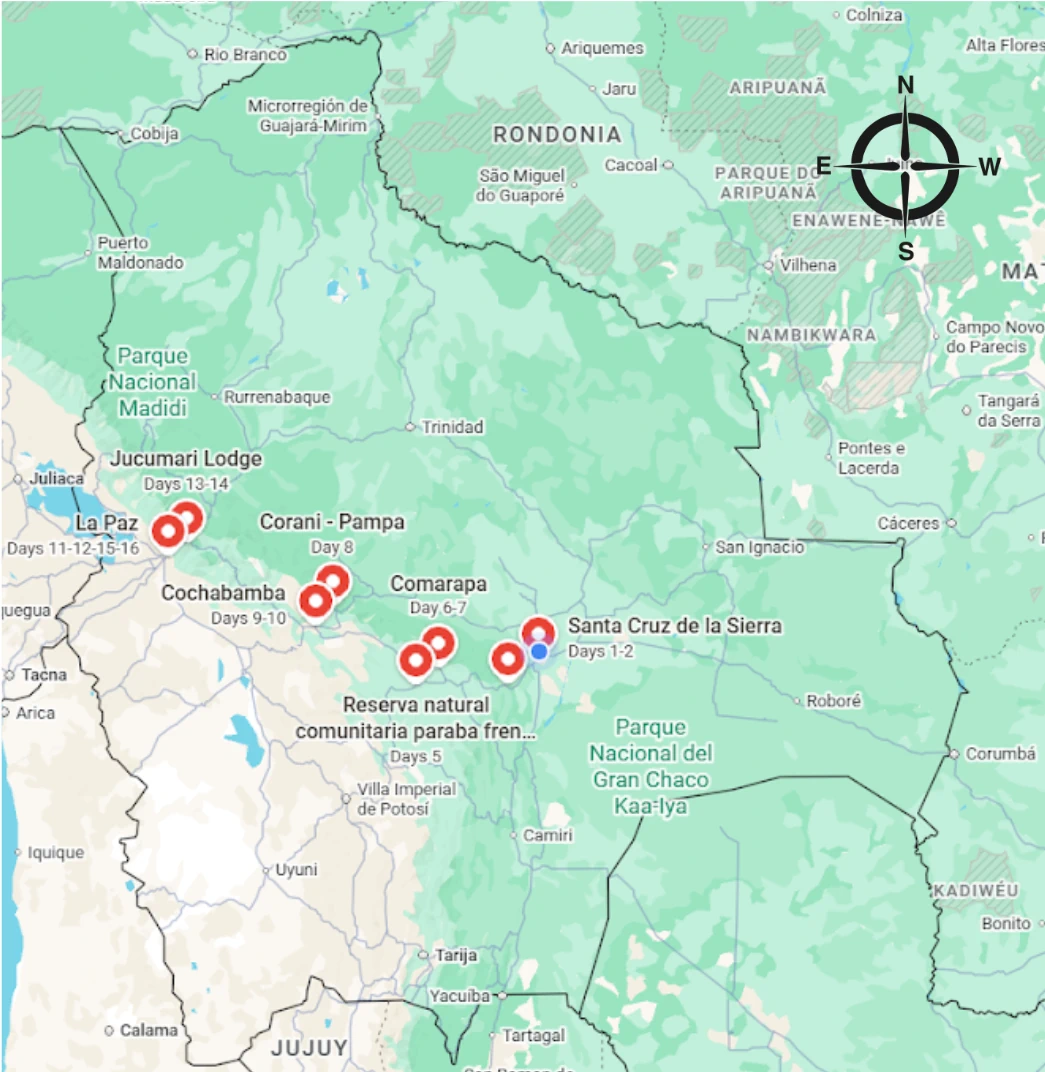
Starting point: Santa Cruz City
Endpoint: La Paz City
Detailed day-by-day itinerary
Day 1
Welcome to Bolivia!
Arrive today at your leisure. Flights reach Viru Viru Airport in Santa Cruz de la Sierra throughout the day. Time permitting, we may do some casual birding near the airport, depending on the flight schedules. The group will officially meet for a welcome dinner this evening.
Overnight in Santa Cruz.
Day 2
We begin our day very early, departing from the hotel towards the best hotspots around the city of Santa Cruz. We are located in the lowlands of Bolivia, at 1,300 FASL.
In the morning, we visit the Lomas de Arena Park, a protected area situated in the northernmost part of the Chaco, where savannas and some forested areas dominate. Depending on the time of year, it is sometimes possible to find lagoons among the sand dunes, which are the emblem and the reason for the park’s name.
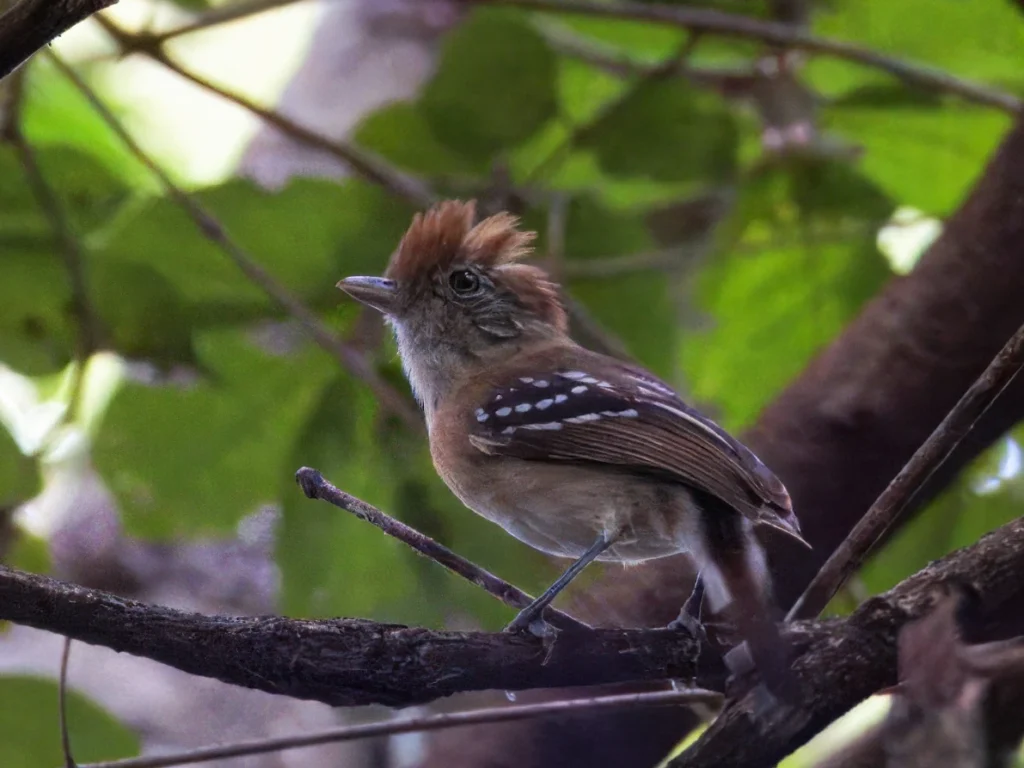
Bolivian Slaty-Antshrike (fem) by Hugo Santa Cruz
In the afternoon, we head to the Botanical Garden, a vast expanse of forest within the city of Santa Cruz, located in the Chiquitanía Ecoregion. The wildlife is so concentrated in this area that it is home to five species of monkeys.
If the weather permits, we end the day at Laguna Guapilo, a body of water that shelters hundreds of birds in the heart of the city.
Overnight in Santa Cruz.
Targets: The main targets will be range-restricted birds, such as the Greater Rea, Red-winged Tinamou, White-bellied Nothura, Red-legged Seriema, Spot-backed Puffbird, Toco Toucan, White Woodpecker, White-wedged Piculet, Bolivian-slaty Antshryke, Chotoy Spinetail, and Chopi Blackbird.
Day 3 and 4
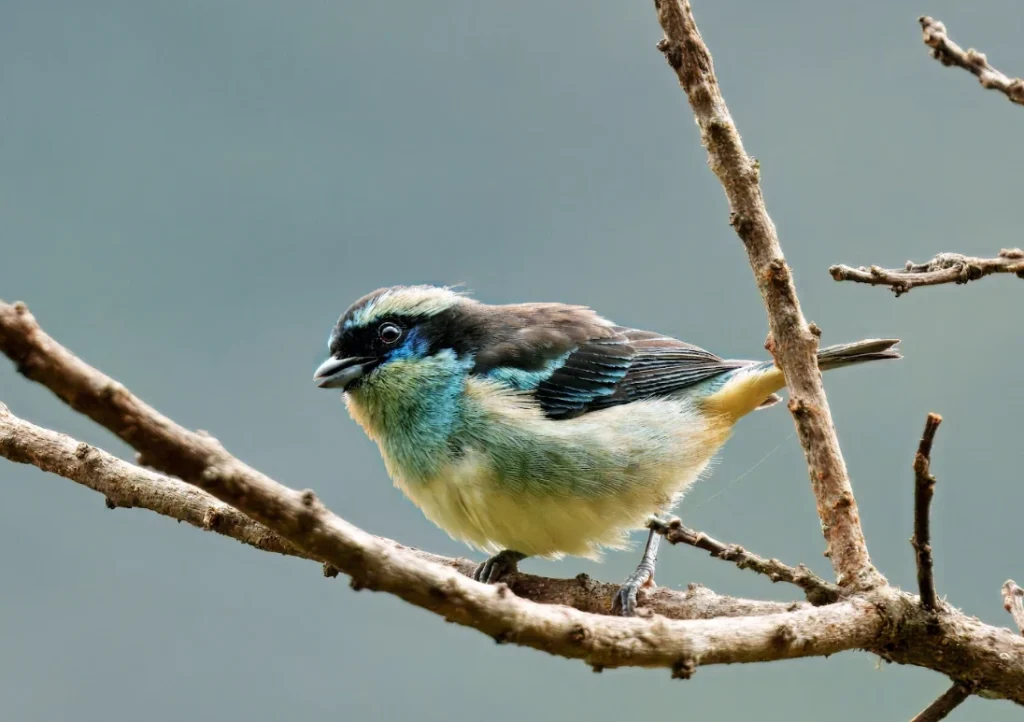
Blue-browed Tanager by Hugo Santa Cruz
Before dawn on our second day, we head toward the southeastern sector of Amboró National Park. Here, the Andes Mountains curve from northwest to southwest, forming the “Codo de los Andes” (Elbow of the Andes), where multiple ecoregions converge, making this park one of Bolivia’s most biodiverse.
Our destination is Refugio Los Volcanes, the top birding hotspot in the Santa Cruz department, according to eBird. This ecolodge hides incredible feathered treasures, which we will seek out along the fascinating trails of the rainforest.
From the moment we arrive, all exploration will be on foot. The trails vary in difficulty, and our walks will be adjusted to the group’s pace.
This part of Amboró National Park lies at the transition between the Northern and Southern Yungas ecoregions, resulting in a rich and diverse birdlife. For two full days, we will immerse ourselves in this vibrant forest teeming with life.
Two nights at Refugio Los Volcanes.
Targets: Bolivian Recurvebill (endemic), Short-tailed- Antthrush, Yungas Manakin, Buff-throated Foliage Gleaner, Gray Tinamou, Brown Tinamou, White-winged Tanager, Blue-browed Tanager, Guira Tanager, Black-googled Tanager, Planalto Hermit, Sparkling Violetear, Fork-tailed Woodnymph, Rufescent Screech-Owl, Tawny-bellied Screech Owl, Sunbittern, Slaty Gnateater, Military Macaw, Green-cheecked Parakeet, Channel-billed Toucan, Ochre-cheecked Spinetail, Red-necked Woodpecker, Gray-throated Leaftosser, Western Fire-eye, Black-streaked Puffbird and Dusky-green Opropendola.
Day 5
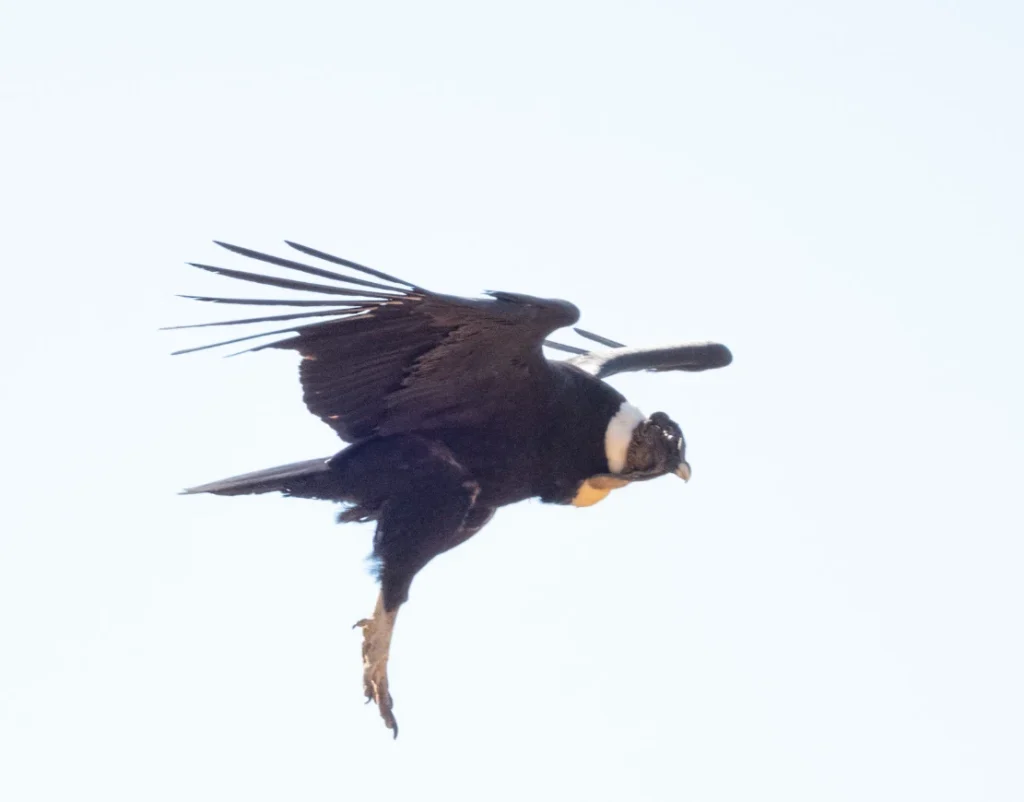
Andean Condor by Hugo Santa Cruz
Today, we have a long journey ahead as we make our way to the Inter-Andean Dry Valleys, passing through the Chaco Serrano along the way until the Red-fronted Macaw Reserve. Most of our birdwatching will take place near the road, with multiple strategic stops at key ornithological sites.
The ecoregion in this area undergoes dramatic changes over just a few kilometers. As we ascend the Andes Mountains, the landscape becomes drier, with less vegetation, giving way to cacti and acacias typical of semi-xerophytic environments. Our route spans mid-elevation ranges, between 1,000 and 2,500 meters (5,250–8,200 ft) above sea level, in a drier climate where the vegetation is noticeably more open and adapted to arid conditions.
Among the highlights of our journey are Km 305 Vicinity, a stunning canyon nestled along the route, with some specialties of the area, and the Jardín de las Cactáceas protected area. We will end the day at the Red-fronted Macaw Reserve.
Overnight at Red-fronted Macaw Lodge.
Targets: Huayco Tinamou, Andean Condor, Bolivian Earthcreeper, Stripe-crowned Spinetail, Giant Antshrike, Rufous-capped Antshrike, Bolivian, Rusty-browed, and Black-and-chestnut Warbling Finch, Band-tailed Sierra Finch, Olive-crowned Crescentchest, Sooty-fronted Spinetail, Green-barred Woodpecker, Ultramarine Grossbeak, and Moss-backed Sparrow.
Day 6
The Red-fronted Macaw Reserve is a community-managed protected area set at 1,500 meters above sea level (5,000 ft), along the banks of the Mizque River. Directly opposite the ecolodge, across the river, rises an impressive cliff that serves as a nesting site for Red-fronted Macaws. This species, along with many other birds, can be comfortably observed from the lodge gardens.
We will have the entire morning to explore this outstanding birding hotspot further, exploring the surrounding habitats, with special attention to endemic species and other local rarities.
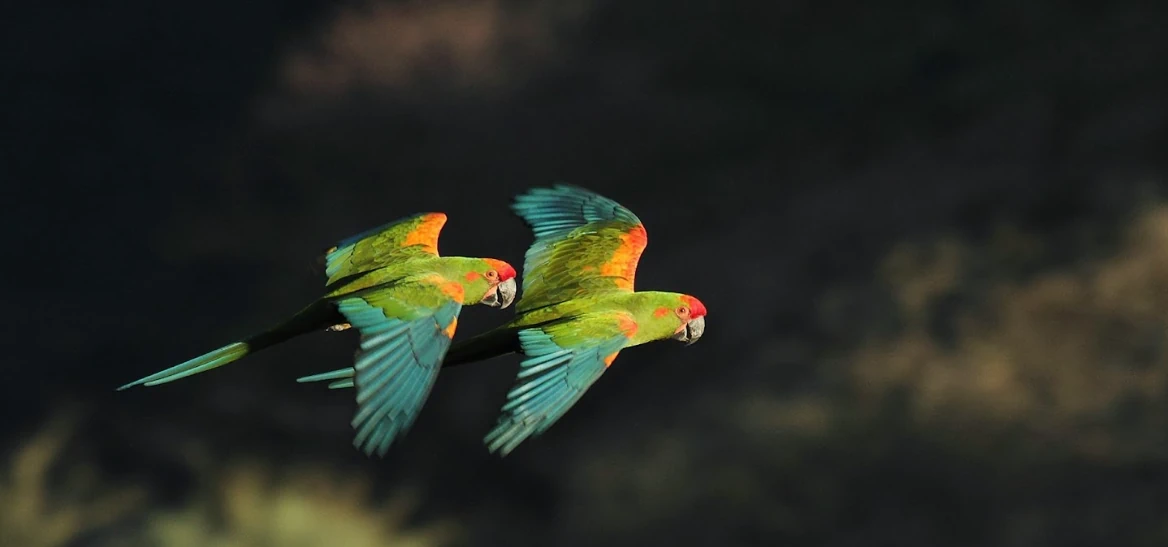
Red-fronted Macaw by Hugo Santa Cruz
In the afternoon, we travel toward the Comarapa area, where we will spend the night. En route, we will make several birding stops, including Laguna Pailones, another excellent hotspot of an ecotone between the Inter-Andean Dry Valleys and the Chaco Serrano. Landscapes here are distinguished by their remarkable diversity of cacti.
Overnight in Comarapa.
Targets: Black-chested Buzzard Eagle, Red-fronted Macaw (endemic), Cliff Parakeet (endemic), Spot-backed and White-eared Puffbird, Striped Woodpecker, White-tipped Plantcutter, White-crested Tyrannulet, Ringed Warbling Finch, Grey-crested Finch, and Bolivian Blackbird (endemic).
Day 7
Early in the morning, we will head into the cloud forests of the Serranía de la Siberia located on the southwestern edge of Amboró National Park. This section of the Southern Yungas is quite distinct: the high mountain range traps what little moisture is available in the atmosphere, creating wet conditions that allow lush, high-elevation forests to flourish on its steep slopes. This site lies at a higher elevation and is considerably wetter than the area we visited earlier in the park.
Despite the often vivid colors of the birds in this ecoregion, seeing them is not easy in the dense mist that frequently blankets the forest. Birding under these conditions is certainly challenging, but that is exactly what makes the experience so rewarding. Here, we will have further opportunities to find endemic and near-endemic species.
Then, we will explore the Astilleros area, in search of new species. The Yungas are always full of surprises—each day brings the unexpected, and with some luck we may encounter rare birds that have been recorded only a handful of times.
Overnight in Comarapa.
Targets: Bolivian and Rufous-face Antpittas, Blue-capped Puffleg, Scaly-naped Parrot, Black-winged Parrot, Bar-bellied Woodpecker, Pearled Treerunner, Highland Elaenia, Buff-banded and Tawny-rumped Tyrannulets, Pale-legged Warbler, Brown-capped and Spectacled Redstars, Superciliaried Hemisphingus, the shy and elusive Slaty Gnateater, Blue-backed Conebill, several Bolivian Brushfinch, Fulvous-headed Brushfinch, Trilling Tapaculo, Blue-winged Mountain Tanager, Sepia-capped Flycatcher, Blue-necked Tanager, Plumbeus Black-Tyrant and Rusty-browed Warbling Finch.
Day 8
Today, we have a long journey ahead to the town of Coranipampa. In the morning, we will explore a little bit more the cloud forest in the Siberia area, continuing our route west toward the department of Cochabamba. We will ascend until 3,500 meters (11,500 ft) above sea level, passing through the Humid Puna, the Inter-Andean Dry Valleys, and the Northern Yungas.
Then we descend to Coranipampa, situated at 7,200 feet above sea level. This is a small, developing village that nevertheless offers comfortable accommodations, where we will spend the night.
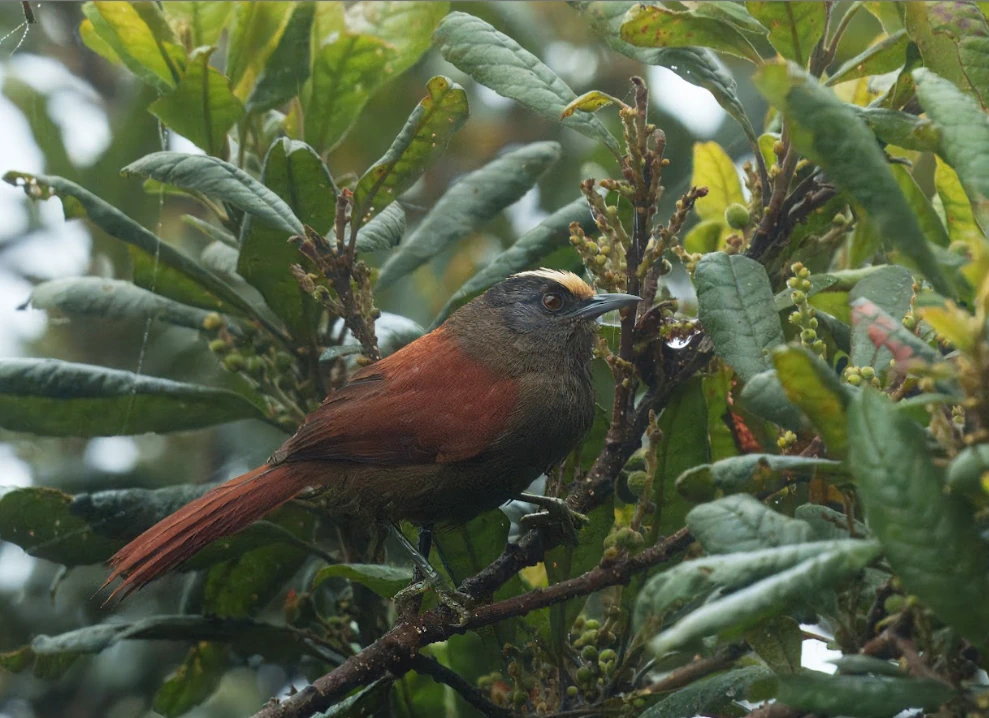
Light-crowned Spinetail (Buffy crowned) by Hugo Santa Cruz
Overnight in Coranipampa.
Targets: Violet-fronted Starfrontlet, Creamy-breasted Canastero, Light-crowned Spinetail, Pale-footed Swallow, White-tipped Swift, Common Chlorospingus, Fawn-breasted Tanager, and Golden-winged Cacique.
Day 9
Today, we wake up in the heart of the Yungas of Cochabamba. Throughout the day, we will explore a range of mid- to high-elevation forests, varying from subtropical to temperate. This area is home to some of the best birding hotspots in the country.
Early in the morning, we head to the rainforests, situated between 1,300 and 1,800 meters (4,265–5,905 ft) above sea level. The landscape is dominated by cecropia trees, a species that attracts birds of every color, from tanagers to toucans.
In the afternoon, we visit the cloud forest, located between 2,500 and 3,500 meters (8,200–11,500 ft). This ecosystem has a mysterious feel, where you can never be sure what you’ll encounter. At times, the mist reduces visibility to just ten meters, and moments later, the sky may clear up. The brightest feathered jewels can easily go unnoticed in this dense fog, even by the most experienced birdwatchers. After a long day of exploration, we head to the city of Cochabamba.
Overnight in Cochabamba.
Targets at the rainforest: Versicolored Barbet, Bolivian Tapaculo, Slaty Tanager, Yungas Tody-Tyrant, Rust-and-yellow and Green-throated Tanagers, Upland Antshrike, Yungas Antwren, White-throated Quail-Dove, Bolivian, Sclater’s and Buff-banded Trannulets, McConnel’s Flycatcher and Flammulated Pygmy-Tyrant.
At the Cloud Forest: Hooded Mountain Toucan, Stripe-faced Wood-Quail, Chestnut-bellied Mountain Tanager, Rufous-faced Antpitta, Trilling Tapaculo, Black-throated Thistletail (endemic), Rufous-bellied Bush-Tyrant, Ochre-faced Tody-Flycatcher, Black-hooded Sunbeam (endemic), and Bolivian Brushfinch (endemic).
Day 10
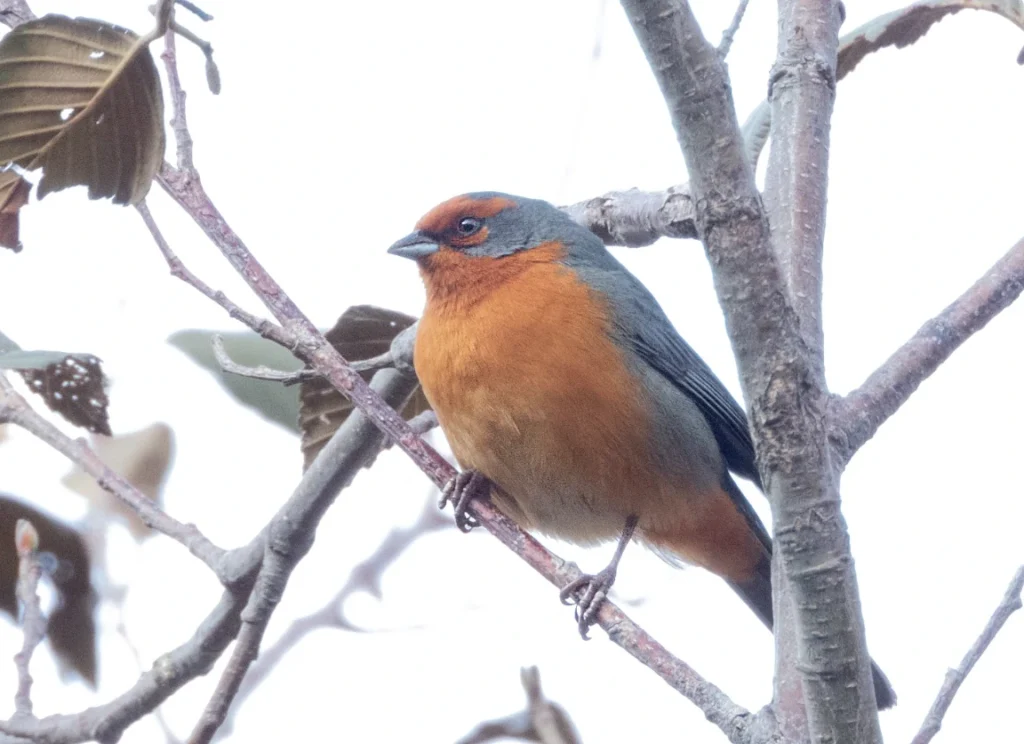
Cochabamba Mountain Finch by Hugo Santa Cruz
Cochabamba is located in the Inter-Andean Dry Valleys at 2,570 meters (8,430 ft) above sea level. From any point in the city, the mountains of Tunari National Park can be seen, our destination for today.
In this protected area, our first goal is to explore the Polylepis forest, home to tall tree species that shelter a variety of interesting species. After passing through the treeline, where the last Polylepis trees mark the transition, we continue our ascent toward the Puna, reaching 4,600 meters (15,100 ft) today. As we climb, we pass through wetlands, lagoons, slopes, and other high-altitude habitats, which, surprisingly, are teeming with life.
Overnight in Cochabamba.
Targets at the Polylepis Forest: Red-tailed Comet, Wedge-tailed Hillstar, Olive-crowned Crescentchest, Bolivian Blackbird (endemic), Giant Conebill, Cochabamba Mountain Finch (endemic), Bolivian Warbling Finch, Streak-fronted Thornbird, Maquis Canastero, Brown-capped and Tawny-tit Spinetails, D’Orbigny’s Chat-Tyrant,
At the Humid Puna: Ornate Tinamou, Darwin’s Nothura, Rufous-naped, Taczanowski’s, Puna, Cinereus and Ochre-naped Ground-Tyrant, Rock Earthcreeper, Slender-billed Miner, Glacier Finch, and Boulder Finch.
Day 11
In the morning, we take a flight to El Alto, a city located next to La Paz. The airport sits at an elevation of 4,100 meters (13,500 feet) above sea level, so it’s important to take necessary precautions before the flight. If you’re prone to altitude-related issues, consider taking medication before boarding.
El Alto lies on the high plains, but as we descend into the valley of La Paz, the landscape gradually begins to change. Towering in the distance is the majestic Illimani, whose snow-capped peak rises to nearly 6,500 meters (21,325 feet)—an unforgettable sight.
Although La Paz is not Bolivia’s capital, it serves as the seat of government. It’s a truly unique city, where millions of Aymaras and mestizos contribute to a vibrant, energetic culture—full of life, yet often chaotic.
In the afternoon, we’ll visit a local protected area: the Bosquecillo de Auquisamaña. This small patch of forest, located in the heart of the city, features a mix of native and introduced plant species.
Targets: Andean Swift, Red-tailed Comet, Giant Hummingbird, Rock Earthcreeper, Plain-mantled Tit-Spinetail, Streak-fronted Thornbird, White-browed Chat-Tyrant, Brown-backed Mockingbird, and Greenish Yellow-Finch.
Day 12
On this day, we will continue our journey across the Altiplano, crossing the mountains of the Cordillera Real in the Andes as we head toward the Sorata Valley, where we will search for two endemic bird species and many other flying jewels.
Then we head to Lake Titicaca, the world’s largest lake by surface area and one of the highest-altitude lakes, located at 3,800 meters (12,500 feet) above sea level. The Aymara community of Humamarka is waiting to guide us on a trip in traditional small boats, rowing in search of the grebe that bears the lake’s name: the “Titicaca Grebe.” We will slowly navigate through the reeds until we reach a viewpoint in the middle of the water. It’s an excellent opportunity for photographers, as some species will allow us to get very close.
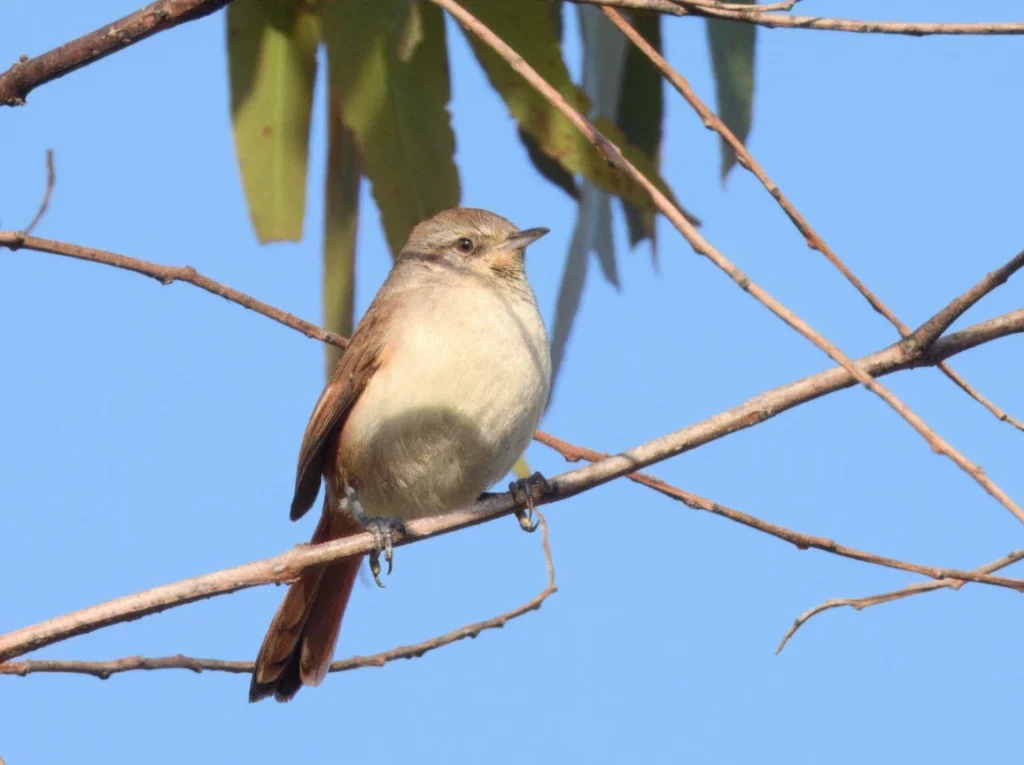
Berlepsch’s Canastero by Hugo Santa Cruz
Overnight in La Paz.
Targets at the lake: Titicaca Greebe, Silvery Grebe, Giant Coot, Chilean Flamingo, James Flamingo, Cinereus Harrier, Andean Flicker, Puna Pipit, and Yellow-winged Blackbird.
At the mountains and valleys: Huayco Tinamou, Black-hooded Sunbeam (endemic), Berlepch’s Canastero (endemic), Scribble-tailed Canastero, Bare-faced Ground Dove, Black-throated Flowerpiercer, Mourning, Peruvian, and Ash-breasted Sierra Finches, and Yellow-bellied Siskin.
Day 13
We will begin our birdwatching at 4,700 meters (15,400 feet) above sea level, in a frigid climate. During the first part of the morning, we will explore wetlands, lagoons, and native shrub vegetation, home to several bird species adapted to the heights of the magical Andes.
Later, we will descend into a completely different landscape. In less than 20 km, we will reach the stunning “Death Road”, a narrow route that drops abruptly to 1,000 meters (3,280 feet) in just 30 km. The name comes from the 1990s, when, before the construction of the new road to Coroico, this route had the highest annual death toll from car accidents worldwide.
In just a few kilometers, we will go from the thick fog of the cloud forest to the warmth of the rainforests in Cotapata National Park, part of the Yungas of La Paz.
Overnight in Acero Marka.
Targets at the Puna: Giant Coot, Rufous-bellied and Gray-breasted Seedsnipe, Golden-spotted Ground-Dove, Slender-billed Miner, White-fronted, Cinnamon-bellied, and White-browed Ground Tyrants, Glacier Finch, and Plumbeus Sierra-Finch.
At Los Yungas: Great Sapphirewing, Greenish Puffleg, Collared Inca, Booted Racket-tail, Long-tailed Sylph, Blue-mantled Thornbill, Montane Foliage-gleaner, Fulvous Wren, Andean Solitaire, White-banded and Buff-banded Tyrannulets, Brown-backed Chat-Tyrant, White-browed Conebill, Hazel-fronted Pygmy-Tyrant, Scimitar-winged Piha, Diadamed Tapaculo, Orange-browed, Superciliaried, Black-eared and Three-striped Hemispinguses, Golden-collared Tanager, Orange-bellied Euphonia, Moustached Flower-piercer, Swallow Tanager and Citrine Warbler.
Day 14
Today we spend the day at Jucumari Lodge, one of the most important birding hotspots in Bolivia’s Yungas region. More than just a lodge, this is a 180-hectare (450-acre) private nature reserve protecting well-preserved cloud forest, complete with waterfalls and crystal-clear rivers. It also serves as a refuge for the endangered Spectacled Bear.
Jucumari Lodge is one of the few places in the region with bird feeders, making it an excellent spot to observe a variety of hummingbirds, tanagers, and more. One of the most sought-after species that visits the feeders is the Rufous-faced Antpitta—a highly local and notoriously difficult bird to see in the wild.
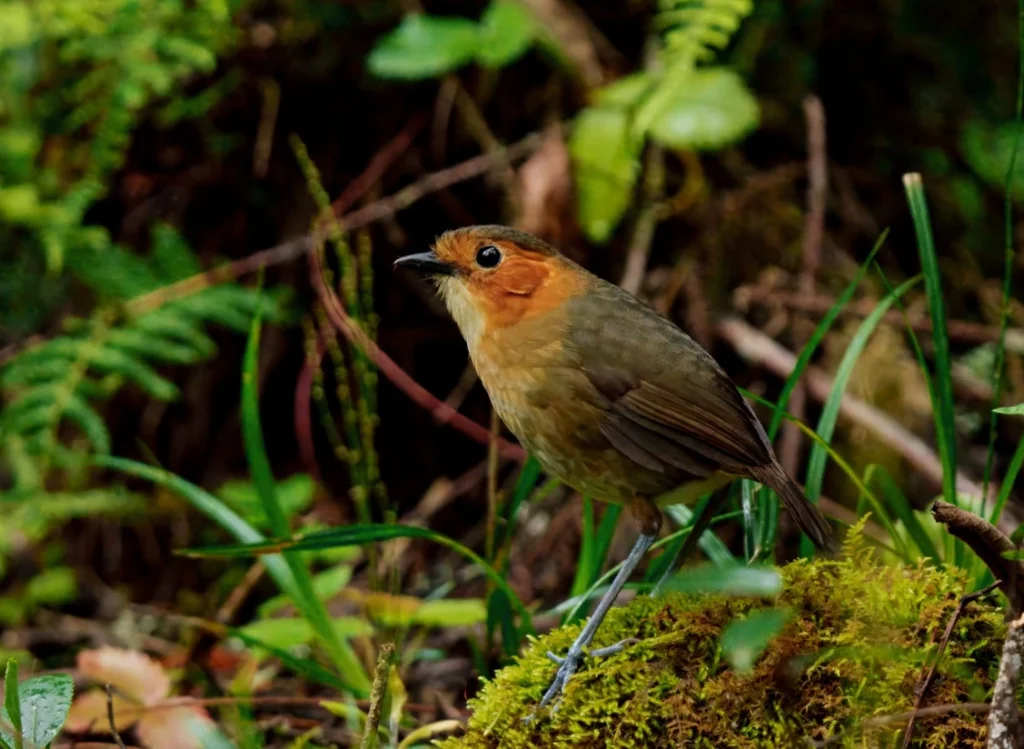
Rufous-faced Antpitta by Hugo Santa Cruz
Within the reserve, we’ll have the opportunity to explore mature forest along a network of trails in search of rare species. At the same time, we can enjoy more relaxed birding right in front of the feeders. The lodge offers something for every kind of birdwatcher.
Overnight at Acero Marka.
Targets: Striped-faced Wood Quail, Andean Parakeet, Great Sapphirewing, Black-hooded Sunbeam, Scaled Metaltail, Gould’s Inca, Violet-throated Starfrontlet (Bolivian), Hooded Mountain Toucan, Crimson Mantled Woodpecker, Black Throated Thistletail, Light Crowned Spinetail, Bolivian, Undulated and Rufous-faced Antpittas, Mountain Cacique, Grey Bellied Flower piercer, Chestnut Bellied, Scarlet and Hooded Mountain Tanagers, and Bolivian Brush Finch.
Day 15
Today marks our final day of birding, and there is no better way to end the journey than with one last session in the beautiful cloud forest of Jucumari Lodge’s private reserve. Surrounded by misty forests and dramatic scenery, we will take our time exploring the trails and enjoying the rich birdlife of this special place, with the chance to add a few final species to our list.
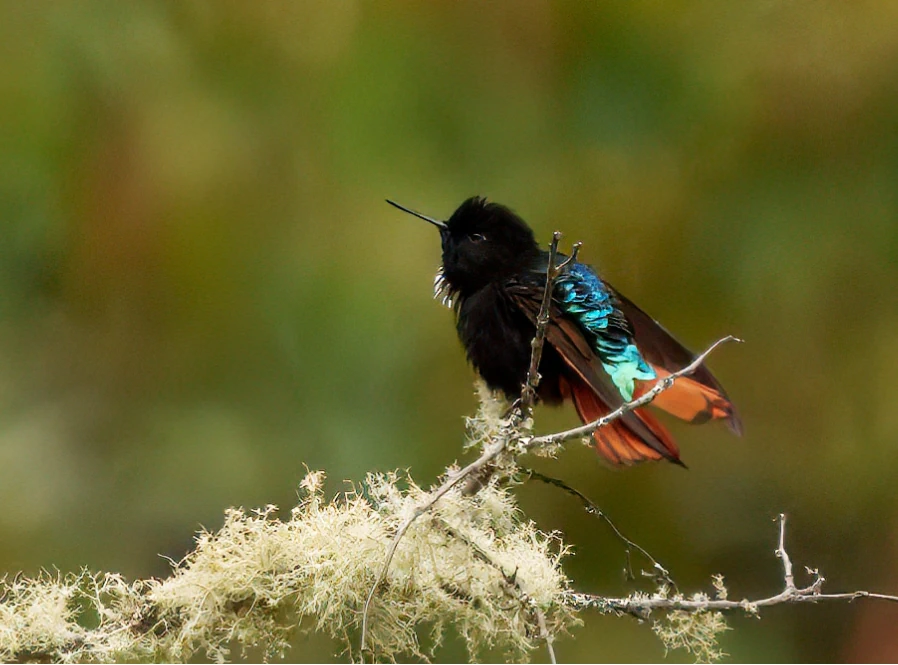
Black-hooded Sunbeam by Hugo Santa Cruz
Later in the day, we will return to La Paz, where we will gather for a farewell dinner to reflect on the highlights of the trip and celebrate the experiences shared along the way.
Targets: Species missed on the previous day.
Overnight in La Paz.
Day 16
Transfers to the airport will be arranged according to individual flight schedules. This marks the end of our services.
Thank you for traveling with us. We wish you a pleasant journey home.
Overnight not included.