
Into the Wild
Bolivia’s Best Mammal Watching in Two Weeks 14D/14N
Bolivia is one of the most biodiverse countries on the planet, home to at least twelve distinct ecoregions. Located in the heart of South America and bordered by five countries, it shares some of the continent’s richest and most spectacular natural landscapes.
Nearly a quarter of the country is protected under national parks and reserves, many of which cover millions of hectares. Vast forests still stretch from the Andes down to the lowland plains, sheltering ecosystems that have remained untouched for centuries.
Thanks to its low population density, Bolivia has preserved large areas of primary forest and pristine wilderness refuges for wildlife that have vanished from much of South America.
While many think of Bolivia as purely Andean, over half the country lies in the lowlands, where endless forests and lush savannas stretch out to the horizon. This is where the Andes meet the tropics, temperate zones, deserts, the Pantanal, and the Chaco—a land of striking contrasts: snow-capped peaks over 6,000 m, vast highland deserts, lush tropical rainforests, and seasonally flooded savannas crisscrossed by the mighty rivers of the Amazon basin.
These forests are still home to jaguars, pumas, and a wealth of other species—some rarely seen and others yet to be described by science. Bolivia remains an undiscovered gem that continues to surprise every visitor.
Because much of Bolivia’s natural wealth is still underexplored, every observation we make on our trips becomes a meaningful contribution to the country’s wildlife knowledge, making your experience not only exciting but also valuable to conservation.
Our mammal-watching destinations are remote and far from mass tourism, ensuring exclusivity and an authentic connection with nature.
Join us for a truly unique adventure as we explore Bolivia’s diverse lowland ecosystems in search of its most iconic and elusive wildlife.
Trip Summary
| Bolivia’s Best Mammal Watching in Two Weeks 14D/14N | |||
| Tour begins in Santa Cruz and ends in Trinidad | |||
| Day # | Itinerary | Remarks | Overnight |
| 0 | Transfers from Santa Cruz airport | Welcome Dinner (D) | Santa Cruz |
| 1 | Wildlife watching around Santa Cruz City | Visit to local protected areas (B,L,D) | Santa Cruz |
| 2 | Santa Cruz to Jaguarland | 6 hours driving approx until the hotspot (B,L,D) | Jaguarland |
| 3 | Jaguarland | Long driving looking for mammlas (B,L,D) | Jaguarland |
| 4 | Jaguarland | Long driving looking for mammlas (B,L,D) | Jaguarland |
| 5 | Jaguarland to Santa Cruz | (B,L,D) | Santa Cruz |
| 6 | Santa Cruz to Kaa-Iya National Park | 8 hours driving approx until the hotspot (B,L,D) | Kaa-Iya National Park |
| 7 | Kaa-Iya National Park | Long driving looking for mammlas (B,L,D) | Kaa-Iya National Park |
| 8 | Kaa-Iya National Park | Long driving looking for mammlas (B,L,D) | Kaa-Iya National Park |
| 9 | Kaa-Iya National Park to Santa Cruz | (B,L,D) | Santa Cruz |
| 10 | Flight to Trinidad | Flight from Santa Cruz to Trinidad (B,L,D) | Trinidad |
| 11 | Trinidad to San Carlos | 5 hours driving approx until the hotspot (B,L,D) | San Carlos |
| 12 | San Carlos Ranch | Long driving looking for mammlas (B,L,D) | San Carlos |
| 13 | San Carlos Ranch | Long driving looking for mammlas (B,L,D) | San Carlos |
| 14 | San Carlos to Trinidad | End of our services (B,L) | Not included |
Tour Route Map
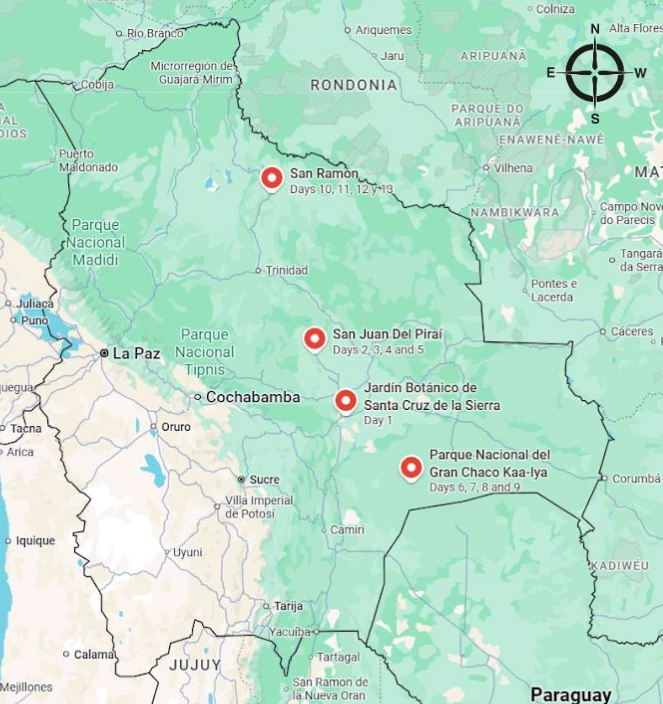
No. of days: Arrival Transfer Day + 14 Full Days
Starting point: Santa Cruz City
Endpoint: Trinidad City
Detailed day-by-day itinerary
Day 0
Welcome to Santa Cruz de la Sierra! Transfers will be arranged according to each passenger’s arrival time. In the evening, we’ll enjoy a welcome dinner and an introduction to the tour.
Day 1
We begin our tour in the morning with a visit to a local protected area within the city: the Botanical Garden. Despite being in the heart of bustling Santa Cruz, this reserve is home to a surprisingly rich variety of mammals.
The Botanical Garden offers an excellent representation of the Chiquitano Dry Forest, the ecoregion where the city is located. What sets it apart from other botanical gardens is its impressive size—220 hectares—right in the middle of the city. Surrounded by a vast “concrete jungle,” this forest has become an important refuge for local wildlife.
The protected area harbors several mammal species, including six species of monkeys and even some carnivores. It is also rich in birdlife and home to a few reptiles.
In the afternoon, we’ll visit a privately protected area known as Ivaga Guazú. Though smaller than the Botanical Garden, it is an excellent place to search for one of our main target primates. Noche en Santa Cruz.
Targets: Brown-throated Three-toed Sloth, Bolivian Squirrel, Southern Amazon Squirrel, Greater Capybara, Black-tailed Marmoset, Black-and-gold Howler, Bolivian Red Howler, Guianan Brown Capuchin, Azara’s Night Monkey, and White-eared Titi.
Day 2
Today we head to Jaguarland Reserve, where we will spend the next three nights. The journey takes approximately six hours, with a stop for lunch en route. We arrive before sunset and begin our first search for mammals (see details in Days 3 and 4). Overnight at Jaguarland.
Days 3 & 4
Jaguarland is a private reserve surrounded by tens of thousands of hectares of farmland, primarily soy plantations. This extensive agricultural development has displaced much of the surrounding wildlife, resulting in a high concentration of animals within the reserve, making sightings of large mammals, including the majestic Jaguar, highly likely.
The reserve lies within the Chiquitania ecoregion, a unique biome found only in Bolivia. Sitting at an average elevation of 400 m (1,300 ft), the terrain is generally flat, featuring medium-height forests, natural grasslands dotted with forest patches, and rivers that belong to the Amazon Basin.
Chiquitania is a transitional zone between the Amazon and the Chaco—neither as humid as the former nor as dry as the latter—making it highly suitable for farming and cattle ranching. Unfortunately, this has driven significant changes in recent decades, with natural forests and grasslands replaced by agricultural land.
During our stay in Jaguarland, we will focus on searching for mammals at different times of the day and night, with all outings conducted in 4×4 vehicles. We spend both nights at Jaguarland.
Targets: Six-banded Armadillo, Brown-throated Three-toed Sloth, Bolivian Squirrel, Southern Amazon Squirrel, Brown Agouti, Lowland Paca, Greater Capybara, Jaguar, Jaguarundi, Ocelot, Crab-eating Fox, Neotropical Otter, Tayra, Crab-eating Raccoon, South American Coati, Lesser Grison, Black-capped Squirrel Monkey, Guianan Brown Capuchin, Azara’s Night Monkey, Black Spider Monkey, Amazon River Dolphin, White-lipped Peccary, Collared Peccary, Common Red Brocket, Common Brown Brocket, Marsh Deer, and Lowland Tapir.
Day 5
After one last early-morning exploration, we begin our return to the city of Santa Cruz. As we’re on the way in, we’ll stop for lunch en route. Overnight in Santa Cruz.
Day 6
Today is another long travel day as we head toward Kaa-Iya del Gran Chaco National Park, the largest protected area in Bolivia, spanning nearly 3.5 million hectares. Our journey takes us through San José de Chiquitos, where we stop for lunch, and past the Santa Cruz la Vieja Historic National Park and the Ñembi Guasu Conservation and Ecological Importance Area—both offering the chance for incidental wildlife sightings, particularly of bird species. (See Kaa-Iya details on Days 7 and 8.) Overnight inside Kaa-Iya National Park.
Days 7 & 8
Kaa-Iya in the Guaraní language means “Lord of the Forest,” a guardian spirit believed to watch over this vast Chaco woodland. Thanks to its immense size and an almost non-existent human presence, Kaa-Iya is regarded as one of the most pristine habitats for South American wildlife.
Life here is not easy—dry seasons can last up to six months, meaning only the hardiest species can survive. Despite these harsh conditions, Kaa-Iya harbors a high concentration of large mammals and is one of the few parks in the world with a thriving population of jaguars. This abundance of top predators supports a remarkably diverse community of fauna, flora, and other life forms.
The Gran Chaco is characterized by vast low forests and dense, dry thorn scrub. It experiences highly seasonal rainfall, and wetlands are scarce, often forcing animals to travel long distances in search of water.
Our exploration focuses on the park’s northern sector, following a perfectly straight, 150-kilometer track built to service a gas pipeline. We will spend many hours along this route in 4×4 vehicles, with occasional walks into the forest to explore its more hidden corners.
Targets: Brown Four-eyed Opossum, Brown-eared Woolly Opossum, Greater Fairy Armadillo, Southern Three-banded Armadillo, Giant Armadillo, Forest Rabbit, Chacoan Mara, Puma, Jaguarundi, Jaguar, Ocelot, Pampas Fox, Crab-eating Fox, Black-tailed Marmoset, Hooded Capuchin, White-coated Titi, Azara’s Night Monkey, Chacoan Peccary, Collared Peccary, White-lipped Peccary, Common Brown Brocket, and Lowland Tapir.
Day 9
After a final morning exploration, we head back to Santa Cruz. En route, we stop in San José de Chiquitos, a former Jesuit Mission, to enjoy lunch and explore its historic main square and nearby attractions. Overnight in Santa Cruz.
Day 10
In the morning, we take a flight to Trinidad, gateway to the Bolivian Amazon. In the afternoon, we visit Chuchini, a private protected area where we’ll search for mammals and other wildlife. Nestled along the Ibare River, with its lagoons and gallery forest, Chuchini is an excellent example of the Amazon ecosystem. Overnight in Trinidad.
Day 11
Today, we depart from Trinidad toward the cattle ranch of San Carlos. Depending on the time of year, access is either by 4×4 or a combination of 4×4 and a small motorboat, perfectly suited for navigating the narrow rivers along our route. We arrive in the afternoon and begin exploring the area. Overnight at Hacienda San Carlos.
Days 12 & 13
San Carlos is a working cattle ranch located in one of the finest areas of the Seasonally Flooded Savannas of the Beni, in Bolivia’s Amazonian lowlands. Covering more than 5,000 hectares, the ranch is primarily used for cattle grazing, yet it shelters abundant wildlife in every corner.
This ecosystem is defined by its vast grasslands, wide meandering rivers, gallery forests, forest islands, and shallow lagoons. The Machupo and San Carlos rivers, which we will navigate, teem with life—countless caimans, some reaching up to five meters in length, hundreds of bird species, and dozens of capybaras.
We will explore each habitat in search of its most iconic species, using 4×4 vehicles, boats, and even horseback. Both nights are spent at Hacienda San Carlos.
Targets: Gray Four-eyed Opossum, Brazilian White-eared Opossum, Nine-banded Armadillo, Bolivian Squirrel, Southern Amazon Squirrel, Brown Agouti, Lowland Paca, Brazilian Guinea Pig, Greater Capybara, Pantanal Cat, Jaguar, Crab-eating Fox, Giant Anteater, Southern Tamandua, Amazonian Long-tailed Porcupine, Brown Agouti, Giant Otter, Tayra, Black-capped Squirrel Monkey, Guianan Brown Capuchin, Bolivian Red Howler, Bolivian River Dolphin, Collared Peccary, White-lipped Peccary, Common Brown Brocket, Amazonian Brown Brocket, Pampas Deer, and Marsh Deer.
Day 14
After one final morning exploration, we make our way back to the city of Trinidad, bringing our unforgettable journey to a close. The timing of our return will depend on each passenger’s onward flight connections.
It has been a pleasure to share this adventure with you. Until we meet again…
End of our services.
Important to know
The target species listed on all days are merely examples of the specialties that may be encountered. Not all possible species are included, and naturally, none are guaranteed to be observed.
While the species mentioned earlier are our primary focus, we also place significant emphasis on all the wildlife we come across during the day, adjusting our approach to the group’s pace and preferences.
We follow the taxonomy of the book “A Field Guide to the Larger Mammals of South America” by R. Webb and J. Blincow.
Additional Information:
Weather conditions may vary significantly throughout the tour. Some areas—such as the Chaco and Chiquitanía—can be very hot, dry, and windy, while others—like the Seasonally Flooded Savanna—may be very humid. Please bring clothing suitable for a wide range of weather conditions, as well as protection against mosquitoes and other insects.
We highly recommend wearing clothing in natural, non-contrasting colors to avoid startling the wildlife we aim to observe.
Expect early morning starts, which will help us make the most of the cooler hours and avoid getting out during the hotter parts of the day.
This tour requires a moderate level of physical fitness. We won’t undertake long hikes, but we can encounter difficult weather conditions that could be uncomfortable.
Accommodation in the three main hotspots is very basic—please do not expect hot showers or air conditioning. Keep in mind that we will be traveling to very remote, non-touristic areas.
Included in the Tour Fee:
- All accommodations during the tour from days 0 to 13
- All meals from dinner on Day 0 to lunch on Day 14. Some meals, such as breakfast and lunch, will be enjoyed in the field, allowing us to maximize our time outdoors
- Ticket Flights from Santa Cruz to Trinidad on Day 10
- Drinking water and other non-alcoholic beverages are available at all times
- Entrance fees to national parks and other natural reserves
- Guiding and transportation services from Day 0 to Day 13
- Professional chef at all the hotspots
Not Included:
- Hotel accommodation on day 14
- Flight back from Trinidad
- Breakfast and lunch of day 0, dinner on day 14
- Visa fees (if applicable)
- Alcoholic beverages
- Travel insurance
- Laundry and other personal expenses
- Tips (gratuities for guides, drivers, lodge staff, or any personnel you feel deserve it are welcome)
For more information, please contact:
Hugo Santa Cruz
www.boliviabirdingexpeditions.com
+591 73988190